
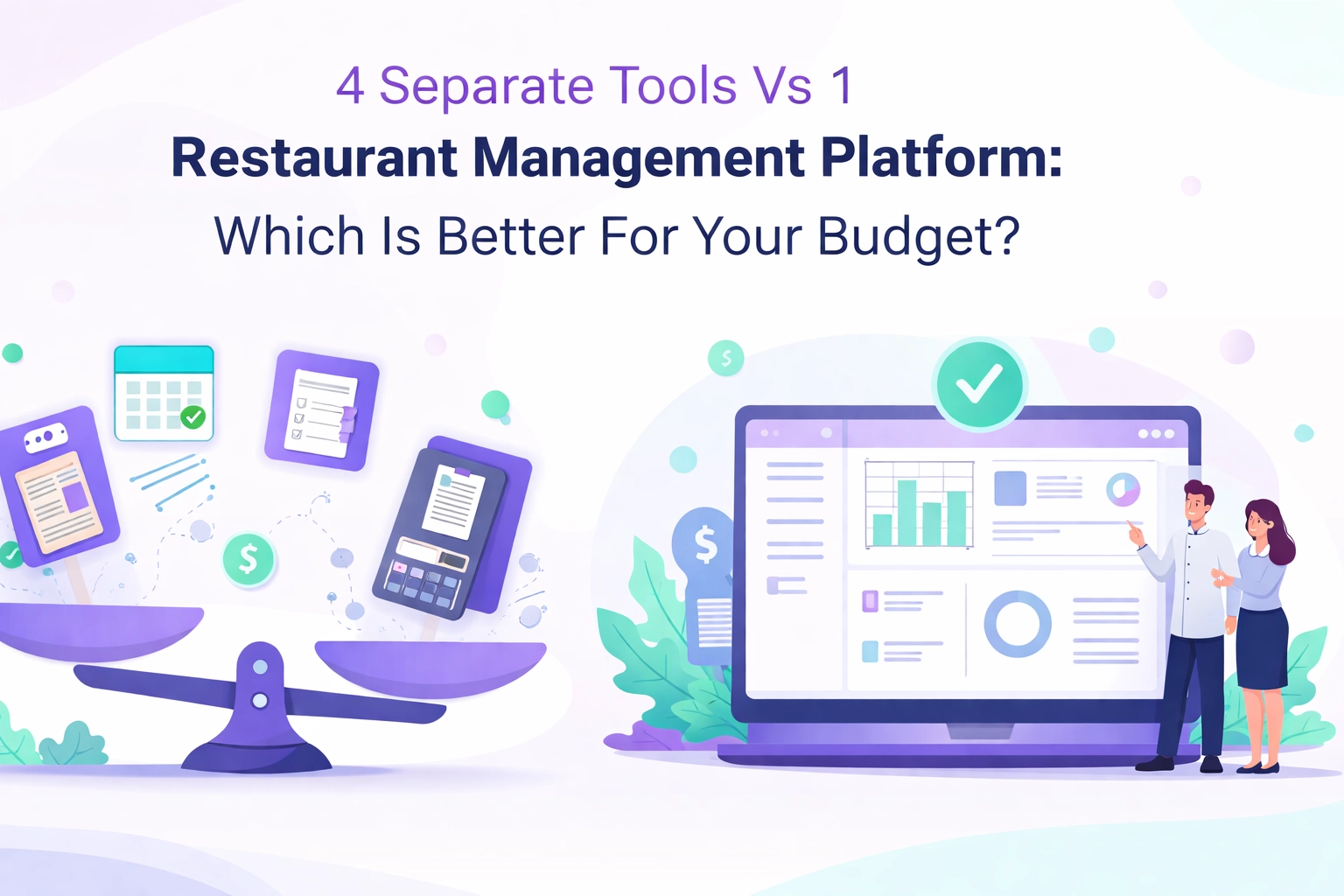
4 Separate Tools Vs 1 Restaurant Management Platform: Which Is Better For Your Budget?
4 Separate Tools Vs 1 Restaurant Management Platform: Which Is Better For Your Budget?
!4 Separate Tools Vs 1 Restaurant Management Platform
You've got a scheduling app. An inventory tracker. Tip distribution software. Maybe a separate tool for purchasing.
Four subscriptions. Four logins. Four customer support lines when something breaks at 6 PM on a Friday.
Sound familiar?
Here's the question that keeps restaurant operators up at night: Is all this software actually saving you money—or bleeding you dry?
Let's break it down.
The Hidden Tax of Running 4 Separate Tools
On paper, those individual tools look affordable. $30 here. $50 there. Maybe $69 for the "premium" plan that actually does what you need.
But here's what the pricing pages don't tell you.
Integration fees. Want your scheduling software to talk to your POS? That's an extra $25 to $200 per month. Per connection. Across four tools, you're looking at hundreds in fees just to make everything play nice together.
Training costs. Every new hire needs to learn four different interfaces. Four different workflows. Four different ways to clock in, check inventory, or view their tips. That's hours of your time. Hours of their time. Hours you're not spending on guests.
Reconciliation headaches. When your inventory numbers don't match your purchasing records, who do you call? When tip calculations look off, which system is wrong? You become the IT department. The detective. The mediator.
!Frustrated restaurant manager overwhelmed by separate software tools

Duplicate features you're paying for twice. Most tools include reporting. Most include some form of analytics. You're literally paying multiple vendors for the same functionality.
Add it all up. That "budget-friendly" stack of separate tools? It's probably costing you $300 to $500 per month when you factor in the real expenses.
Plus your sanity.
What a Restaurant Management Platform Actually Costs
An all-in-one restaurant management platform typically runs between $60 and $300 per month.
One subscription. One login. One support team.
No integration fees. No data reconciliation nightmares. No playing tech support at 11 PM when two systems stop syncing.
Let's look at what that includes:
- Inventory management – Track stock levels, set par levels, automate purchase orders
- Tip distribution – Calculate pools, splits, and payouts in seconds
- Employee scheduling – Build shifts, handle swaps, manage availability
- Purchasing – Order from suppliers without the email chaos
Four functions. One platform. One price.
The Math Doesn't Lie
Let's run the numbers on a typical mid-size restaurant.
Scenario A: Four Separate Tools
| Tool | Monthly Cost |
|------|-------------|
| Scheduling software | $69 |
| Inventory management | $79 |
| Tip distribution | $49 |
| Purchasing/ordering | $59 |
| Integration fees (2 connections) | $75 |
| Total | $331/month |
That's $3,972 per year. Before you count the hours lost to troubleshooting, training, and manual data entry.
Scenario B: All-in-One Platform
| Platform | Monthly Cost |
|----------|-------------|
| Integrated restaurant management platform | $150 |
| Integration fees | $0 |
| Total | $150/month |
That's $1,800 per year.
You save $2,172 annually. Just on subscription costs.
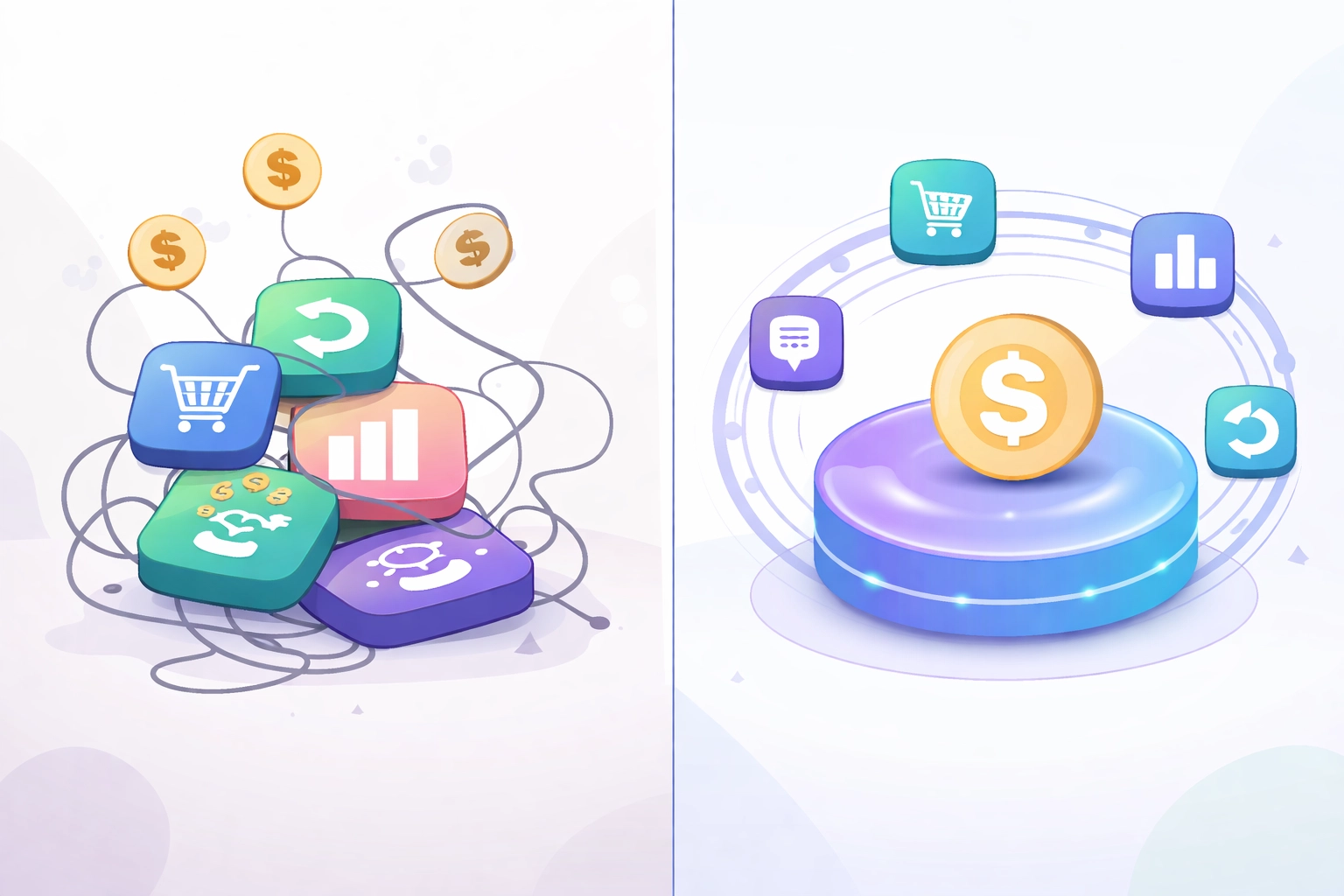
Now factor in the time savings. No more copying data between systems. No more chasing down discrepancies. No more teaching new hires four different apps.
Conservative estimate? You're saving 5-10 hours per week on admin work.
At a manager's hourly rate, that's another $10,000+ per year in recovered productivity.
But Wait—What About Flexibility?
Here's the argument for separate tools: "I want best-in-class for each function."
Fair point. Some standalone tools are genuinely excellent at one thing.
But here's the reality for most restaurants.
You don't need "best-in-class" inventory management that was designed for Fortune 500 supply chains. You need inventory management that works for your 20 suppliers and talks to your scheduling system so you know who to call when you're short on prep staff.
Context matters more than features.
When your tip distribution software knows your scheduling data, it can calculate tip pools accurately without manual input. When your inventory system knows your purchasing history, it can suggest orders automatically.
Separate tools can't do that. Not without expensive integrations. Not without manual work.
When Separate Tools Actually Make Sense
Let's be fair. There are situations where individual tools win.
You only need one function. If you're a tiny operation and literally just need scheduling software, don't pay for features you won't use. Check out a focused solution like ShiftTide that can grow with you later.
You have extremely specialized needs. Some high-volume operations need enterprise-grade inventory systems with features most restaurants never touch. In that case, specialized tools might be worth the integration hassle.
You're locked into long-term contracts. If you're stuck in annual agreements with multiple vendors, timing your switch to an all-in-one platform takes planning.
For everyone else? The math points one direction.
What to Look for in a Restaurant Management Platform
Not all platforms are created equal. Here's what actually matters:
Modular design. You should be able to use the features you need without paying for bloat. Want tip distribution and scheduling but not inventory yet? That should be an option.
Real-time sync. Data should flow between functions instantly. When an employee clocks out, their hours should immediately appear in tip calculations. No delays. No manual exports.
Simple onboarding. If it takes two weeks to set up, you've already lost. Look for platforms that get you running in days, not months.
Mobile access. Your managers aren't always at a desk. Your staff definitely isn't. Everything should work on phones.
Transparent pricing. No hidden fees. No surprise charges for integrations or "premium support." What you see should be what you pay.
!Restaurant manager confidently using an all-in-one restaurant management system on a tablet

The Real Question: What's Your Time Worth?
Restaurant margins are thin. We all know that. Every dollar matters.
But so does every hour.
When you're spending 10 hours a week managing software instead of managing your restaurant, that's a cost too. When your GM is troubleshooting sync errors instead of coaching staff, that's a cost.
When tip disputes happen because data didn't transfer correctly between systems, that's a cost to your culture.
The cheapest tool isn't always the cheapest option.
An integrated restaurant management platform costs more than a single $30/month app. But it costs less than four separate tools, their integration fees, and the hours you'll never get back.
Making the Switch
Already running multiple tools? Here's how to transition without chaos.
Most restaurants complete the switch in under a month. The time investment pays back within the first quarter.
The Bottom Line
Four separate tools feel flexible. They feel like you're building a custom solution.
But flexibility without integration is just fragmentation.
One restaurant management platform gives you everything working together. Lower costs. Less complexity. More time for what actually matters—your guests and your team.
The math is clear. The question is whether you're ready to simplify.
Ready to see what an all-in-one platform looks like? Check out xTide and explore how TipTide, StockTide, and ShiftTide work together. No credit card required.
Ready to try xTide?
Start your free 30-day trial and see how xTide can streamline your restaurant operations.
Start Free Trial